Dry ice blasting vs. sanding and chemicals for mold and soot
Three ways to clean a charred or moldy surface, and why the gentlest one is not always the right one.
October 1, 2026 · 4 min read
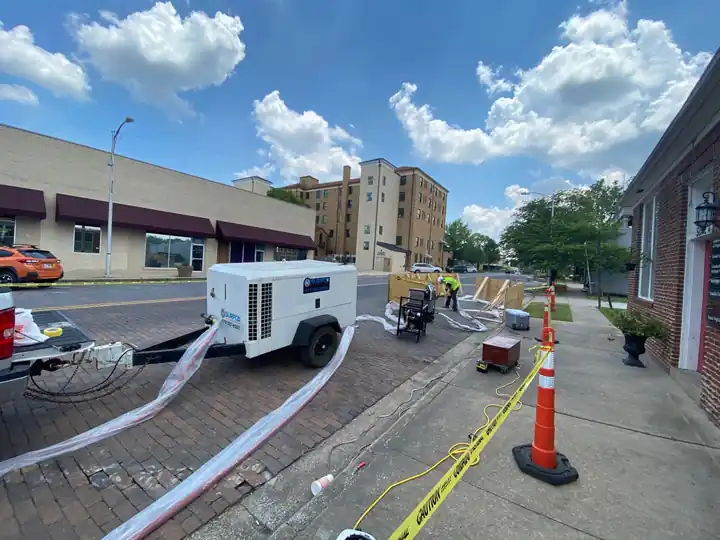
When mold has colonized a stud wall or soot has coated a ceiling, the choice of cleaning method has real consequences. Some methods remove the contamination and leave the structure intact. Others remove the contamination along with a layer of the wood, or leave something behind that causes its own problems. This article compares three common approaches, sanding, chemical treatment and dry ice blasting, so you can ask better questions when you are choosing a contractor.
How sanding works, and what it costs you
Sanding and wire brushing are the traditional answer for surface mold on framing and for charred wood. The idea is to abrade away the contaminated surface until clean wood is showing. It is familiar, and in the right hands it works.
The downside is that it is slow and labor-intensive, and it removes material. Every pass takes a little of the wood with it. It also puts a great deal of fine dust into the air, and when the thing being sanded is mold or soot, that dust is what you are trying not to spread. Crews have to contain the area carefully and clean up afterward, and the abraded surface can end up rougher than the original.
How chemical treatment works, and where it falls short
Chemical treatments use cleaners, biocides or sealers to kill or lift contaminants. They have a place, especially for finishing and for surfaces that cannot be blasted or sanded. The limits are practical ones. Chemicals need time on the surface, they can leave residue, and they do not physically remove the dead material unless something else does. A surface treated chemically may also need to be rinsed or wiped, and that means water, and extra water is something you do not want to introduce into a structure that has just been dried.
What dry ice blasting is
Surfco describes dry ice blasting as a fast remediation method that uses high-velocity, high-density dry ice to clean surfaces without damaging the structure or creating new waste streams. Small pellets of solid carbon dioxide are fired at the surface with compressed air. On impact, the pellets turn straight from solid to gas.
Three properties follow from that, all of which Surfco highlights on its dry ice pages:
- It is non-abrasive. The pellets evaporate on impact, so they leave no residue, scratches or contaminants behind.
- It is chemical-free and non-conductive, which makes it safe for use on electrical materials as well as most other surfaces.
- It uses no water and no sand, so there is no wet slurry or spent media to haul away. The only waste is whatever came off the surface.
Where each method fits for mold and soot
On mold, dry ice blasting removes the growth from framing and masonry without grinding away the wood underneath. That matters on structural lumber, where you want to take as little as possible. On soot, it lifts residue from surfaces and from tight places that a sander cannot reach. Surfco says it frequently uses dry ice blasting for mold remediation, fire damage restoration, asbestos abatement and lead paint abatement.
Surfco also notes that the machinery it cleans this way goes well beyond buildings. Its list includes electrical equipment, heat exchangers, evaporators, generator fans, transformers, stators and rotors, and gas turbine cleaning. That is a useful clue for property managers: if a method is safe around electrical gear, it is gentle enough for a lot of delicate surfaces.
Sanding still makes sense in some cases, for example where the surface itself is badly damaged and has to be taken back to sound material anyway. Chemical treatment can be a finishing step. A good contractor will tell you which of these they plan to use and why, not just sell the one they own.
A fair word about media blasting
Dry ice blasting is not the same thing as media blasting, and Surfco offers both. Media blasting, sometimes called sandblasting, is the right tool for rust, graffiti and old paint, and Surfco uses it for jobs from removing paint on concrete to cleaning slate roofs. It is abrasive by design. If the goal is to strip something off a hard surface, that is the point. If the goal is to clean a delicate or electrical surface without touching it, dry ice is the better fit.
Things dry ice does not do
Cleaning a moldy or sooty surface still dislodges what was on it. Even with no sand and no water, the removed material has to be captured, which is why containment and air filtration remain part of a responsible job. Dry ice also turns into carbon dioxide gas, so the work area needs ventilation and the crew needs training to work safely around it. Surfco says its staff are fully accredited and trained to perform dry ice blasting in line with state regulations and industry guidelines, and that it takes every precaution to keep the work site safe.
Questions to ask any contractor
- Which method do you plan to use on this surface, and why?
- How will you contain the area and control dust or spores?
- What waste will the job produce, and who removes it?
- Will you clean up anything that gets left behind, such as residue or spent media?
- Who has been trained and certified to run the equipment?
Surfco is an IICRC Certified firm with Arkansas Commercial Contractor License 0359010427. If you have mold, soot or a fire-damaged structure and want to understand which method makes sense, call 479-287-6205. The team can look at the surface and tell you what they would do and what they would not.
Surfco Restoration & Construction, 479-287-6205
Call 479-287-6205More articles
What to do in the first hour after water damage
The first hour will not repair your house, but it decides how much repair there is to do.
Asbestos in older Northwest Arkansas buildings: what to know before you renovate
If the building is older, the inspection comes before the sledgehammer.