Asbestos in older Northwest Arkansas buildings: what to know before you renovate
If the building is older, the inspection comes before the sledgehammer.
October 1, 2026 · 4 min read
Most renovation projects begin with a vision: a wall comes out, the kitchen opens up, a tired office gets a new layout. In an older building, there is a step that has to come before any of that. Someone needs to find out whether the materials you are about to cut, sand or tear out contain asbestos. This article explains where it tends to hide, what Surfco recommends before you start work, and what proper abatement involves.
Why age matters
Surfco's guidance on asbestos is direct. Asbestos was not officially banned for use in buildings until 1986, so a large share of homes and commercial properties in Bentonville, Rogers, Fayetteville and the rest of Northwest Arkansas may contain it. Surfco recommends a full asbestos inspection for any property built before 1980. If you are thinking about renovating, the inspection should come first.
Those two dates are Surfco's own statements, and they are a useful rule of thumb rather than a guarantee either way. A newer building can still contain old salvaged materials, and an older one may have had its asbestos-containing materials replaced years ago. The only way to know is to have the materials identified by someone qualified.
Where asbestos shows up
Many owners picture asbestos as old pipe insulation and nothing else. Surfco points out that it appears in a much wider range of materials:
- Flooring
- Plaster
- Textured ceilings and ceiling tiles
- Register vents
- Vermiculite coating
- Plumbing fixtures
- Sheetrock
- Duct wrap
- Roof shingles
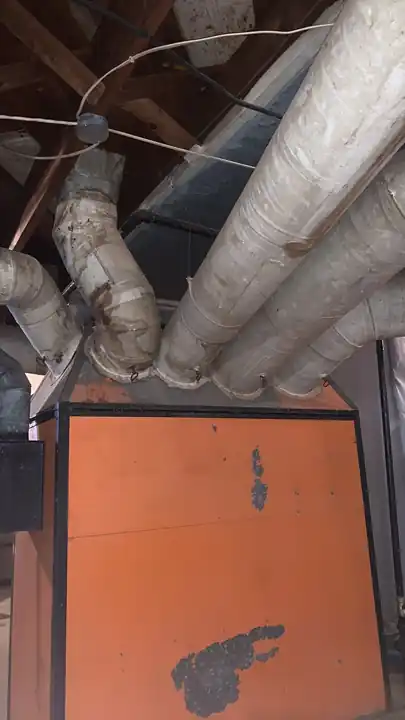
The photo with this article shows wrapped ductwork above an opened ceiling, which is exactly the kind of place a remodel exposes. Duct wrap and ceiling materials sit out of sight until someone opens the space, and that is when the question comes up.
Signs that call for an inspection
Surfco lists several situations in which you should call an abatement company:
- Your building was built before 1980
- You are planning to remodel
- Your property contains damaged building materials
- You have crumbling drywall or popcorn ceilings
- You suspect your property has asbestos
Notice that planning a remodel is on the list by itself. You do not need to see damage. The act of cutting into materials is the risk, which is why the inspection belongs at the start of the schedule, before demolition, flooring, drywall or ceiling work is booked.
Do not test it yourself
This is the point Surfco stresses most, and it is worth repeating plainly. You should never perform an asbestos inspection yourself. Scraping a sample or breaking off a piece of ceiling can disturb the material and send fibers into the air you and everyone else in the building will breathe. If you find something suspicious in the middle of a project, stop work, leave the material as it is, and call.
A few practical habits help while you wait. Keep people out of the area. Do not sweep or vacuum the debris. Consider shutting down the air handler so air is not pulled through the work zone. And tell every trade on the job, from the framer to the flooring installer, that work in that area is paused.
What an inspection and abatement involve
Surfco describes its inspection as comprehensive, using non-destructive techniques to check for signs of contamination. If the inspection finds asbestos-containing materials that are likely to be disturbed by your planned renovation, abatement is the next step.
Abatement does not always mean removal. Surfco notes that in many cases removal would send fibers into breathable air, so sealing the material off to prevent any disturbance is often preferable. When removal is the right answer, it is done with controls in place. Surfco brings negative air machines, HEPA air filters, and the abatement equipment recommended by the Arkansas Department of Environmental Quality and Energy. Negative air machines keep the work area under lower pressure than the rest of the building so air flows in rather than out, and HEPA filtration captures fine particles before the air is exhausted.
Who should do the work
Surfco's position is that only a renovation contractor with special training and the right techniques is qualified to perform abatement in Arkansas. Ask any contractor you are considering to show you their credentials rather than taking it on faith. Surfco's Arkansas Commercial Contractor License is number 0359010427, and the state register lists an asbestos classification alongside its building classification. Surfco also holds ADEQ certification and an IICRC Certified firm designation, and its team is ICRA accredited for work in healthcare environments.
Planning around the answer
For landlords and facility managers, the inspection is also a scheduling tool. A tenant improvement or build-out in an older commercial space goes much more smoothly when the asbestos question has already been answered, because there is no surprise stop-work in the middle of a lease deadline. Surfco also does tenant improvements and demolition, so abatement, tear-out and rebuild can be coordinated under one roof.
For homeowners, the logic is the same, only the stakes are personal. The people who breathe the air during and after a renovation are your family. A few days spent on an inspection is a small cost in the context of that.
If your building is older and a project is on the horizon, call Surfco at 479-287-6205 before anyone picks up a tool. The team works from offices in Springdale and Bentonville and can set up an inspection and talk through the options for your property.
Surfco Restoration & Construction, 479-287-6205
Call 479-287-6205More articles
What to do in the first hour after water damage
The first hour will not repair your house, but it decides how much repair there is to do.
After a tornado or storm: board up, moisture testing and starting the insurance claim
The order matters: make it safe, make it secure, find the water, then build the claim.